

As Food Safety Standards Rise, Quality HACCP Training Becomes the Difference Between a Plan on Paper & a Plan That Works
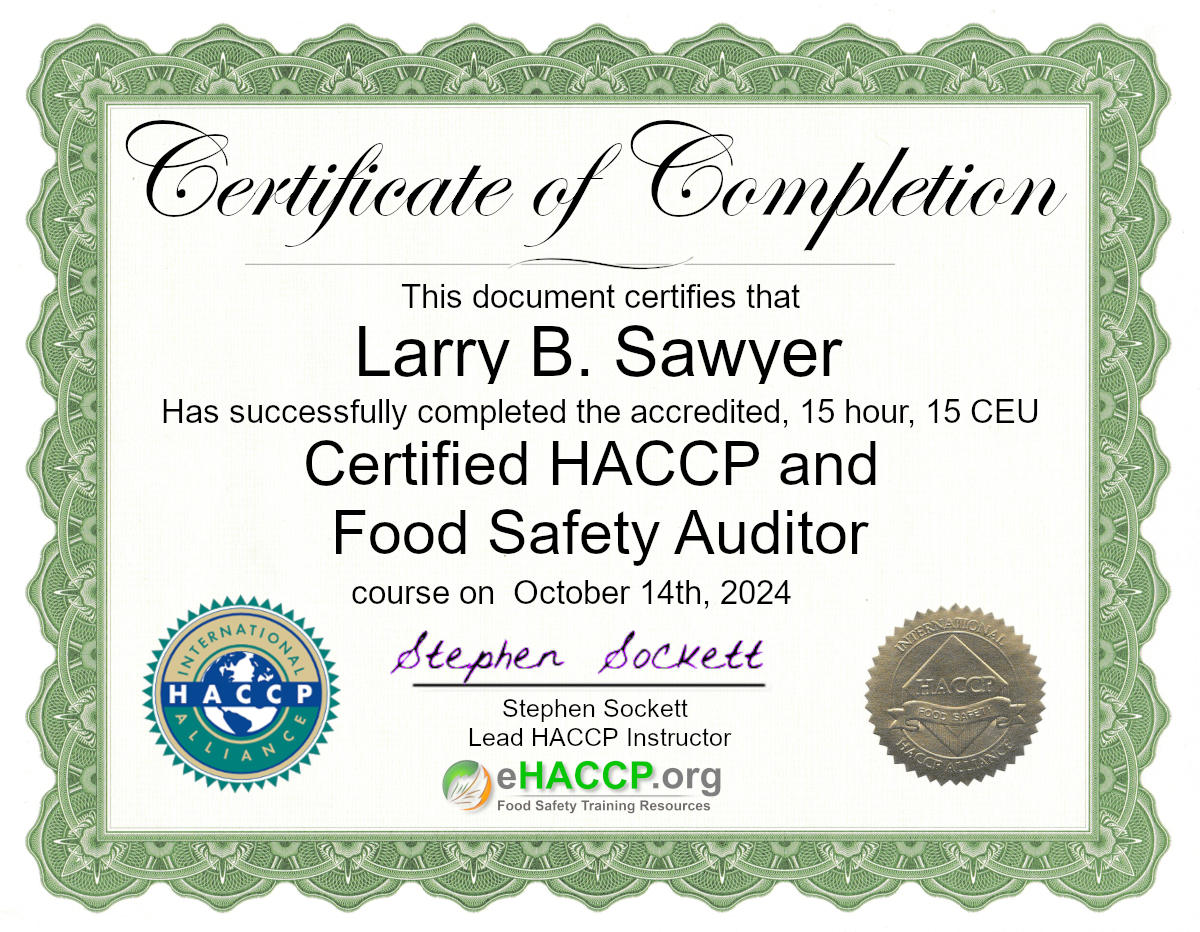
HACCP Auditor certificate
Regulators and certification bodies are demanding evidence of real competence, and the research shows how training can deliver it.
I had a great experience with eHACCP.org. The HACCP and GMP courses are informative and easy to follow, and the course materials are helpful for understanding food safety concepts.”
LUNENBURG, NS, CANADA, September 28, 2026 /EINPresswire.com/ -- HACCP is about to change again. Over the next several years it will become more data-driven, more connected, and more closely tied to sustainability goals, with sensors, artificial intelligence, and digital traceability moving from pilot projects into everyday plant operations. Regulators and certification bodies are also raising expectations for how food safety teams prove they know what they're doing. — Iris Zhang
The message from every direction is consistent: the technology matters, but the people running it matter more.
Twenty-five years of proof
The U.S. Department of Agriculture's (USDA) Food Safety and Inspection Service (FSIS) has built meat and poultry safety on HACCP since its landmark 1996 rule, Pathogen Reduction; Hazard Analysis and Critical Control Point (HACCP) Systems. Looking back on the anniversary, FSIS Administrator Paul Kiecker put it simply: "Food safety is an ever-evolving process."
The numbers back up the shift. A peer-reviewed study by Williams and Ebel, cited by FSIS, found that Salmonella contamination on broiler carcasses fell 56 percent between 1995 and 2000, which translated to roughly 190,000 fewer illnesses tied to broilers in the final year. William Shaw, FSIS's Executive Associate for Laboratory Services, said the program was "a paradigm shift for the Agency," and that the need to verify it produced the large-scale microbial testing program the agency still runs today.
The FDA has taken the same path. Its Food Safety Modernization Act builds directly on the agency's earlier HACCP experience in seafood and juice. FSMA also requires facilities to have a Preventive Controls Qualified Individual, someone with specific training or equivalent job experience, which makes qualified training a legal necessity for many manufacturers.
The certification world is moving the same way
Private certification schemes are pushing just as hard. BRCGS, which is used by more than 22,000 food manufacturing sites in over 130 countries, is developing its tenth issue. FSSC 22000 is built on ISO 22000:2018, and Clause 7.2 of that standard requires organizations to demonstrate, at audit, that everyone affecting food safety is competent.
SQF has been especially direct. HACCP sits at the core of its certification, and the SQF Institute advises companies to choose training grounded in Codex Alimentarius principles, such as courses recognized by the International HACCP Alliance. With SQF Edition 10 arriving in 2026, the emphasis falls on food safety culture, change management, environmental monitoring, and audit scoring.
"Auditors won't be looking for a policy binder," said LeAnn Chuboff, SQFI's Vice President of Technical Affairs. Instead, she explained, they want evidence that food safety is part of daily work, honestly assessed, and continually improved.
In other words, a certificate on the wall from a course taken years ago no longer tells auditors much.
What the research says about training that sticks
A growing body of scholarly work shows why training quality makes the difference. Structured HACCP training has been linked to measurable gains in knowledge and fewer observed handling violations. But knowledge fades, and refresher training is recommended roughly every three years. Post-training assessments can also predict how well a HACCP team will perform, which lets employers step in before something goes wrong.
Delivery matters too. Interactive modules, gamification, and classroom technology improve engagement and pass rates across different kinds of learners. Research also cautions that knowledge alone does not guarantee compliance. The programs that work best also address the barriers and attitudes that keep people from following procedures. And because the food industry relies heavily on migrant and non-native-language workers, training has to be culturally and linguistically adapted to reach them.
Looking ahead, the scholarly literature describes a HACCP that uses real-time sensors for continuous monitoring, AI to forecast hazards, and blockchain to strengthen supply-chain verification. Early "Green HACCP" pilots that build water, energy, and waste monitoring into HACCP plans have reported water savings of about 20 to 25 percent and energy savings of about 10 to 15 percent. Each of these tools still depends on a trained person who understands the hazards well enough to use it.
Why it matters now
Traditional training often treated HACCP as a management-only administrative burden. Today, leading operations realize that the system only works if frontline operators possess the technical expertise to recognize when a system is drifting out of alignment. Modern, high-impact training focus heavily on building a shared safety culture that ensures safety is a collective, floor-level responsibility where employees are celebrated for catching errors early. and strengthening prerequisite programs (PRPs) force standardizing foundational procedures like sanitation standard operating procedures (SSOPs), allergen cross-contamination protocols, and traceability before an emergency occurs. And equipming team members to be able to conduct dynamic plan vVerification to constantly use scientific evidence to validate and update the food safety plan as new risks emerge. These practices are what keeps HACCP evolving for the good of humanity.
eHACCP.org offers online HACCP training built on Codex Alimentarius principles and aligned with International HACCP Alliance standards, the same benchmark the SQF Institute points employers toward. The course is designed to build competence, confidence, and the kind of culture that today's auditors are looking for, not just to produce a completion record.
eHACCP.org is a leading online platform that provides Hazard Analysis and Critical Control Points (HACCP) training and food safety certification courses. Founded in 2007 and headquartered in Lunenburg, Nova Scotia, Canada, the company specializes in self-paced, fully online educational programs designed for food manufacturers, processors, producers, and distribution professionals
Stephen Sockett
eHACCP.org
+19023437763 ext.
email us here
Visit us on social media:
LinkedIn
Facebook
YouTube
X
Other
Legal Disclaimer:
EIN Presswire provides this news content "as is" without warranty of any kind. We do not accept any responsibility or liability for the accuracy, content, images, videos, licenses, completeness, legality, or reliability of the information contained in this article. If you have any complaints or copyright issues related to this article, kindly contact the author above.
