

Daily AI Users May Gain False Confidence In Writing Skills While Real-Life Communication Skills Atrophy, Study Finds
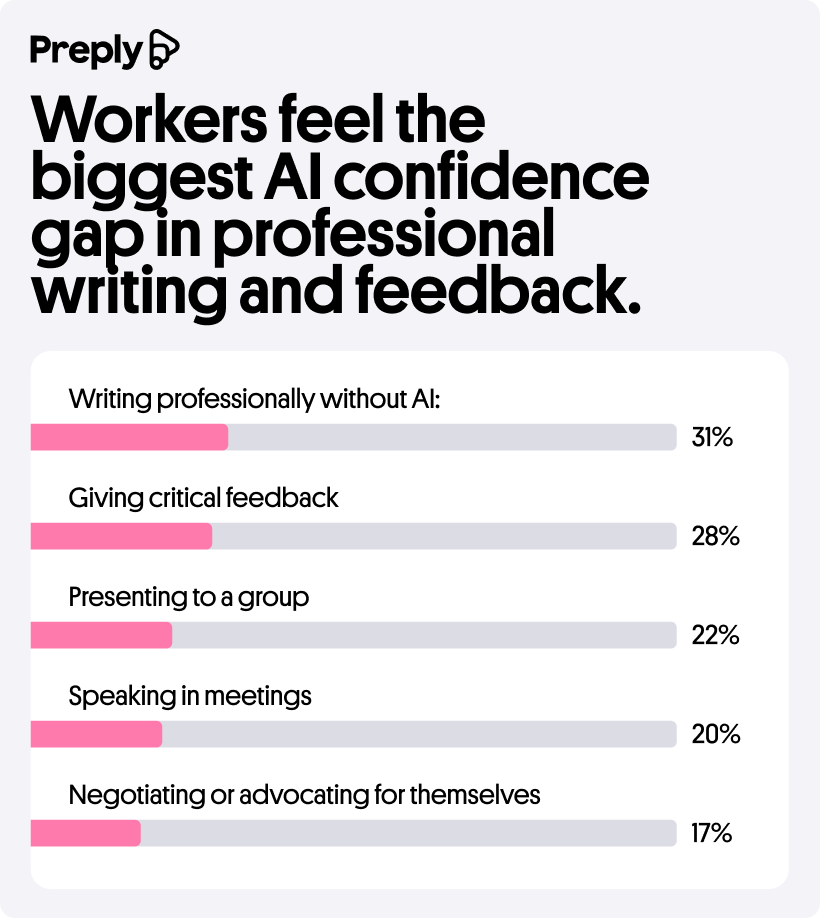
Workers feel the biggest confidence gap in professional writing and feedback
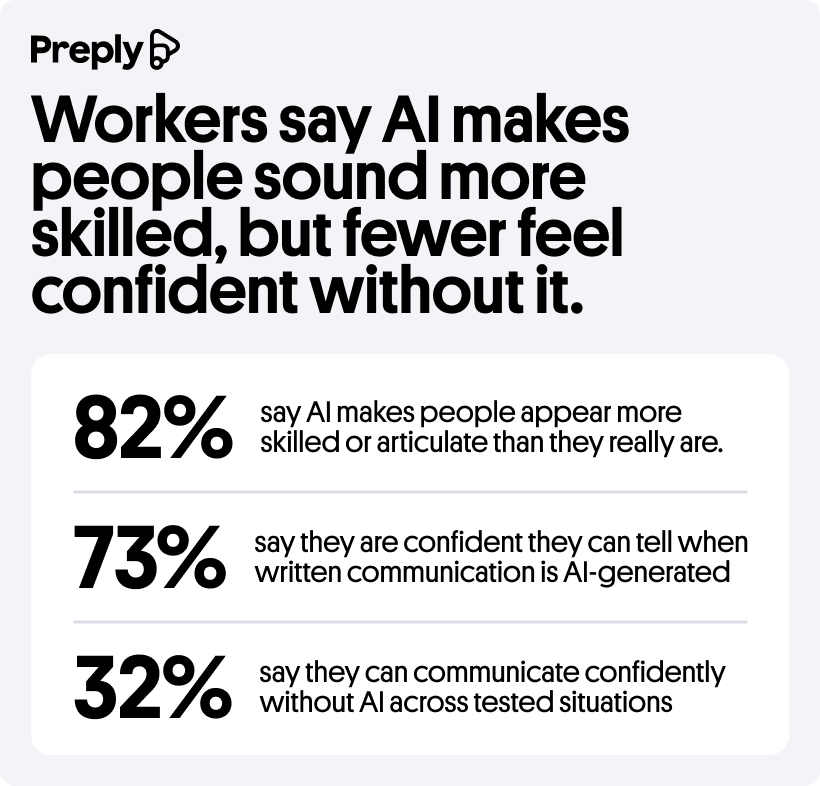
Less than a third can confidently communicate without AI
40% admit relying on AI for communication has reduced their confidence in live conversations—including 55% of Gen Z workers
AI can help craft a message, but it cannot replace the human judgment that gives those words meaning. That still depends on how well we listen, respond, and adapt to the person in front of us.”
NEW YORK CITY, NY, UNITED STATES, June 9, 2026 /EINPresswire.com/ -- A new study from Preply finds that workers who use AI for writing every day at work may be gaining inflated self-confidence in their communication skills, leading to worse outcomes for in-person communications and situations where AI isn’t available. — Madeline Enos
Preply surveyed more than 1,000 U.S. workers to better understand how AI is reshaping workplace communication. The AI and Workplace Communication Survey revealed that many workers are experiencing an AI-driven communications skills atrophy.
-Nearly 1 in 3 workers (33%) use AI to write work communications multiple times a day
-63% of workers use AI to avoid difficult conversations at work
-More than half (51%) say using AI has made spontaneous conversation feel more difficult, rising to 66% among Gen Z
-44% say they sometimes freeze up in in-person conversations because they can’t review or edit their words first.
Among workers who use AI for writing every day at work, 71% say their confidence in their own communication skills has increased because of AI, compared with 53% of workers overall, yet their in-person confidence shows a clear gap. Daily AI users were more likely to report decreasing confidence communicating without AI when:
-Presenting to a group: 28.7% of daily AI users felt less confident, versus 21.9% overall
-Giving critical feedback: 33.7% versus 28.0% overall
-Writing professionally: 37.7% versus 31.1% overall
-Speaking in meetings: 26.8% versus 20.5% overall
-Networking or socializing at a professional event: 23.5% versus 16.6% overall
The AI-driven communications atrophy effect is so dramatic that more than half (51%) say using AI has made spontaneous conversation feel more difficult, jumping to 66% for Gen Z workers. And 44% report they sometimes freeze up during in-person conversations because they cannot review or edit their comments first.
The study also found that daily AI users are more aware of the “AI polish gap,” where tools may help people sound more skilled or articulate than they feel in person. Among daily AI users, 86% say AI makes people appear more skilled and articulate than they really are, compared with 82% of workers overall. Daily AI users are also more confident in their ability to spot AI-generated writing, with 81% saying they can identify it, compared with 73% overall.
The report suggests that AI can be a powerful tool for drafting, editing, translating, and preparing for difficult conversations. But it also raises a new workplace communication challenge: as workers increasingly rely on AI for written communications, they will need more opportunities to practice the live, human conversations that builds meaningful confidence and true communication skills.
Methodology
Preply’s 2026 AI and workplace communication survey was conducted in collaboration with Dataframe in May 2026 among 1,142 U.S. respondents. Of those, 1,002 respondents indicated either full- or part-time employment. Percentages have been rounded where applicable.
Zach Capers
Dataframe LLC
+1 703-350-9569
email us here
Legal Disclaimer:
EIN Presswire provides this news content "as is" without warranty of any kind. We do not accept any responsibility or liability for the accuracy, content, images, videos, licenses, completeness, legality, or reliability of the information contained in this article. If you have any complaints or copyright issues related to this article, kindly contact the author above.
